
FREEZELINK BLOG
AGRIC & PHARMACEUTICAL COLD CHAIN INSTITUTE
From 50% Loss to Global Success: The Cold Chain Opportunity in Accelerating Export Development
Ghana’s ambition to forge a “24-Hour Economy” is a bold one. Yet, for the nation’s burgeoning agriculture sector, operating around the clock is less a matter of policy than of physics. Perishable goods wait for no one. This makes developing a robust national cold chain a critical, and often overlooked, economic imperative.
But how can this vital infrastructure be financed and built? What policies must be in place to support it?
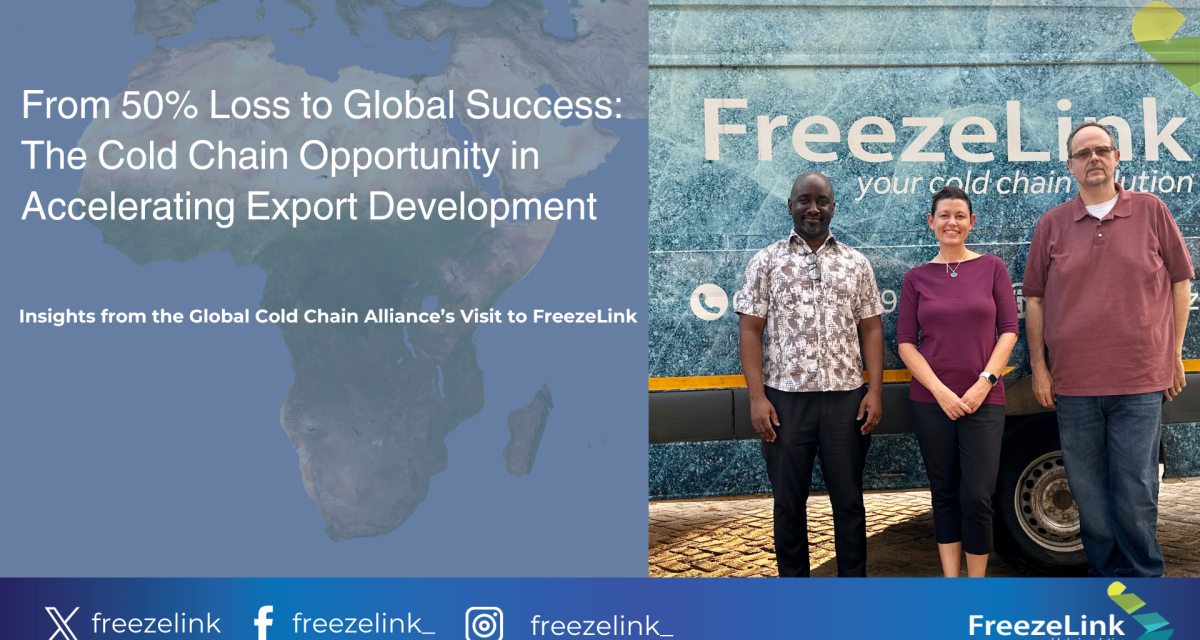
During a recent courtesy visit to Freezelink’s Accra office, we explored these questions with senior figures from the Global Cold Chain Alliance (GCCA). Amanda Brondy and James Eason offered insights gleaned not just from Africa, but from their observations on leveraging cold chain to boost food security and accelerate export development across global growth markets in Asia and Latin America. They sat down with Freezelink’s team to discuss the blueprint for Ghana’s cold chain future.
Here are the key takeaways from that conversation.
The 50% Problem: Why Production Isn’t Enough
The new government’s focus on enabling businesses to operate 24/7 is a massive opportunity, and the GCCA applauds the strong focus on the cold chain as part of this vision. The benefits are clear: reduced food waste, environmental gains, and the preservation of nutritious, perishable products.
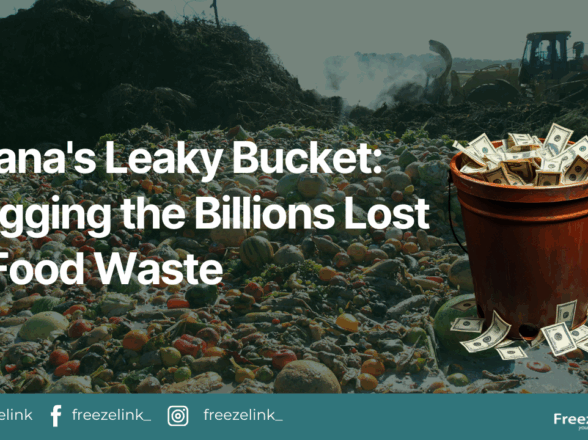
The alternative is staggering. While exact figures for Ghana are elusive, post-harvest losses are estimated to be anywhere from 40% to 50%. One producer recently cited losing 45–50% of his sweet potatoes post-harvest, and then an additional 30% during the export transfer process. These losses reflect what we previously described as “Ghana’s leaky bucket” — the idea that no matter how much we grow, value drains away without the infrastructure to preserve it.
🔗 https://freezelink.co/ghanas-leaky-bucket-plugging-the-billions-lost-to-food-waste/
For a country aiming to scale its food economy, focusing on production without controlling these losses is “throwing money down the drain”. To compete globally, Ghana must deliver both quantity and quality. For perishable products, this is impossible without an unbroken cold chain—a system that includes pre-cooling, refrigerated transport, and modern storage.
The Primary Hurdle: Access to Finance
The single biggest challenge hindering the growth of this infrastructure is “access to affordable finance”. The problem, as GCCA Technical Advisor James Eason explained, is that governments often lack systems that create transparency in inventory. Without this, inventory cannot be collateralized, and banks cannot lend against it.
A Proven Solution: The Kenya Warehouse Receipt Model
A clear solution already exists. Mr. Eason pointed to Kenya’s warehouse receipt system as a model Ghana could follow. This system, which applies to all commodities including highly perishable fruits and vegetables, provides a direct answer to the finance problem.
Here is how it works:
● One-Stop Shop: Kenya established bodies like KenInvest and the Huduma one-stop shop to handle the process.
● Traceable Receipts: When an importer brings in a product—for example, 50 tons of poultry—they are issued a formal warehouse receipt.
● Government Monitoring: Government bodies monitor the product’s entry, tariffs, and port issues.
● Verified Collateral: The system tracks the goods to a specific, identified warehouse. This traceable receipt becomes a verified asset.
● Bank Financing: This verified asset is precisely what enables banks, such as Kenya’s Equity Bank, to confidently finance the inventory.
This model provides the “security blanket” that supply chain actors need to invest and operate. It was this type of systemic, government-backed push—combining best practices, capacity building, and bank partnerships—that grew Kenya’s horticulture and flower export market to $2 billion annually.
The Strategy: Start with Gateways and Hubs
For any nation, the cold chain’s growth is almost always driven by high-value export markets.
The money and demand are in exports, and this is what builds the initial infrastructure. This means the “first point of entry” for a national cold chain is at its ports and airports.
Without this gateway infrastructure, products either fail to get out in time or arrive in poor condition, causing exporters to lose clients. Alongside these gateways, Special Economic Zones (SEZs) are crucial hubs for processing and logistics. SEZs are powerful tools because they:
● Attract foreign direct investment for processing and production.
● Lower costs by operating with no tax and no duty.
● Create a “multiple market push” for value-added, white-label products.
● Enable governments to purchase and lease shared equipment, giving vital access to SMEs who could not otherwise afford it.
The Ultimate Prize: An Economic “Force Multiplier”
When a country gets its cold chain right, the economic prize is immense. The U.S. Department of Commerce once called the cold chain a “force multiplier” because it can grow so many other industries that depend on it.
The benefits extend far beyond economics to food security, nutrition, and public health. As Mr. Eason starkly put it, “whatever you don’t spend in cold chain, you will spend in health”.
The Path Forward: Policy, Partnership, and Expertise
Achieving this vision cannot be done by the government alone; it requires an ideal partnership model.
1.Government’s Role (Policy): The public sector’s role is to create sound policies that support, not hinder, the industry’s growth. This includes educating officials to ensure cold chain equipment is not heavily taxed as a non-agricultural item, but understood as a vital component of the modern food supply chain.
2.Private Sector’s Role (Expertise): The private sector, which the GCCA views as its key partner, brings the operational expertise, innovation, and execution.
3.The Future (Technology): This industry is rapidly moving away from a “blue-collar” misconception. The future is in high-skill jobs: “logistical engineers” and technicians who manage automation, AI, and data algorithms to run automated warehouses. This transition will bring greater accuracy, lower costs, and enhanced food safety.
Ultimately, the ‘so what’ for Africa is a stark choice. We can continue to invest heavily in production only to see up to 40% of that value lost, or we can invest in the systems that secure it. We can remain exporters of raw commodities, or we can build the integrated hubs that process and export high-value, finished goods.
Ghana’s 24-Hour Economy and the continent’s vision for Accelerated Export Development are built on the same premise: that African value must be preserved. The cold chain is not just a part of this strategy; it is the vital, load-bearing architecture that makes it possible
For a global alliance like the GCCA, having local African leadership at the table to adapt global best practices to continental challenges is “incredibly critical”. Freezelink is proud to be at the center of this conversation, affirmed by our CEO’s recent appointment as the first African to the board of governors of the Global Cold Chain Foundation. As Ghana builds its 24-Hour Economy, it is this bridge between local expertise and global best practice that will ensure our perishable exports succeed.
.
GET IN TOUCH