
FREEZELINK BLOG
AGRIC & PHARMACEUTICAL COLD CHAIN INSTITUTE
With Our Farmland Disappearing, Every Single Tomato Counts.
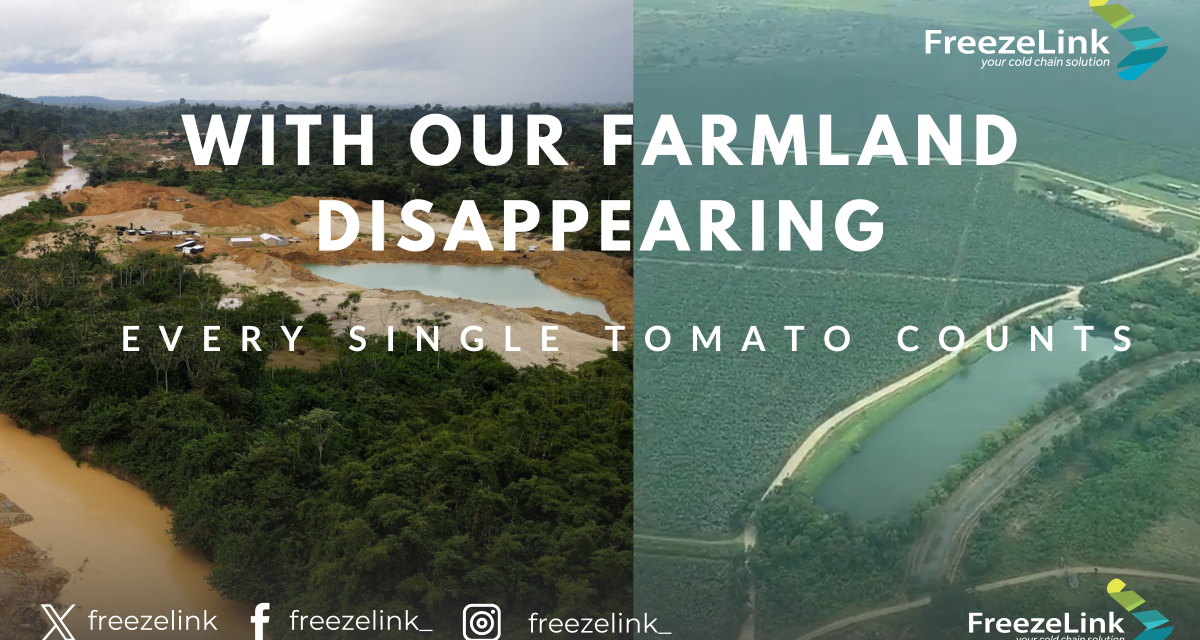
There are two devastating images of waste in Ghana today. One is familiar: a pile of luscious mangoes, harvested in the morning’s heat, now sits rotting by a roadside. The other is newer, and far more permanent: a landscape of what was once fertile cropland, now a toxic moonscape of craters and poisoned water, sacrificed for a few grams of gold.
For years, the first image was seen as a problem of economics. The second reveals it as a crisis of existence. The national conversation about post-harvest loss has long been framed by profit and loss statements. But this is dangerous. As illegal small-scale mining, or galamsey, annihilates Ghana’s arable land at an alarming rate, the justification for preserving our harvest has shifted irrevocably. Investing in the cold chain is no longer a private-sector issue of increasing farmer margins; it is a public-sector imperative of national survival.
But this investment cannot be ad hoc. A refrigerated truck is useless if the perishable produce has already deteriorated waiting under the sun; a cold storage warehouse is a monument to waste if there is no refrigerated transport to get the food to market. What Ghana needs is an unbroken cold chain, a seamless network of preservation from the farm to the palm of the consumer.
The Galamsey Catastrophe: Quantifying Our Disappearing Farmland
The scale of the agrarian crisis is staggering. Recent reports confirm the ruin of vast tracts of agricultural land, with some sources noting over 100,000 acres of cocoa farms have been destroyed by galamsey activities. This is part of a wider trend of destruction that has rendered tens of thousands of hectares of fertile land unusable. The rate of destruction is accelerating, driven by factors including surging global gold prices that fuel the illegal mining rush. This crisis has reached a tipping point, prompting urgent warnings from Ghana’s highest scientific and medical bodies.
The “Zero-Loss Dividend”: A Bankable Revenue Stream
In this new reality, an integrated cold chain acts as a strategic multiplier for our remaining agricultural output. Ghana’s current post-harvest losses are a luxury we can no longer afford. For key crops, the figures are calamitous, with spoilage rates estimated at 40-60% for fruits and vegetables like mangoes, tomatoes, and chilli peppers. An unbroken cold chain—one that provides immediate pre-cooling at the farm gate, is connected by a network of refrigerated vehicles, and is supported by
modern cold storage hubs—could slash these losses by 75%.
The dividend from this act of preservation is transformative. Based on current production volumes, this would rescue over a million metric tons of food annually and hold an import substitution value of over $400 million. This economic potential is not theoretical. One need only look to Kenya, where a strategic focus on the cold chain unlocked a horticultural export market now worth over $1.5 billion annually.
National Need: Policy for a Bankable Future
The challenge is not a lack of viable projects, but a need for smart policy that de-risks and attracts private capital. A cold chain project is attractive to investors because it is asset-backed and generates predictable cash flows from service fees. Ghana would not be the first to treat a food supply chain as a national mission. In the 1970s, India’s “Operation Flood” built a vast national cold chain for milk, transforming the country into the world’s largest producer. The lesson is clear: government direction can unleash private-sector execution.
The government’s role is to create an enabling environment through policies such as:
● Reclassifying End-to-End Cold Chain Logistics as Critical Infrastructure to signal long-term stability and prioritise integrated, systemic solutions for investors.
● Establishing a Public-Private Infrastructure Fund, potentially using a portion of the Minerals Development Fund as a catalyst for larger private investment, with a mandate to prioritize projects that demonstrate full “farm-to-market” integration.
● Launching “Green Land Bonds” to fund cold hubs in agricultural zones threatened by galamsey, providing a clear asset class for investors.
The conclusion is inescapable. In an era of diminishing fertile land, a rotting tomato is a threat to our future. By creating the right policy framework, the government can unleash the private capital needed to build the unbroken, farm-to-consumer cold chain that turns this urgent challenge into a story of resilience, profitability, and national survival.
References
(1) “Ghana Calls It Galamsey: It Is Nothing But ECOCIDE!!!”, GBC Ghana Online, September 2025. https://www.gbcghanaonline.com/commentary/ghana-calls-it-galamsey-it-is-nothing-but-ecocide/2025/
(2) “Ghana’s Galamsey Gold Rush Fuels Environmental and Economic Crisis”, City AM, September 26, 2025.
https://www.cityam.com/ghanas-galamsey-gold-rush-fuels-environmental-and-economic-crisis
(3) “Pure Earth, EPA study finds high levels of arsenic, lead, mercury in galamsey areas”, MyJoyOnline, September 21, 2025.
https://www.myjoyonline.com/pure-earth-epa-study-finds-high-levels-of-arsenic-lead-mercury-in-galamsey-areas/
(4) “GMA Declares Galamsey Water Contamination an ‘Existential Threat”, GhanaWeb, September 23, 2025.
https://www.ghanaweb.com/GhanaHomePage/NewsArchive/GMA-declares-galamsey-water-contamination-an-existential-threat-1928374
(5) “Fresh Produce and Nuts Exports from Kenya in 2022, By Country”, Statista. This report notes fresh produce exports valued at over 166 billion Kenyan Shillings, equivalent to over $1.5 billion USD.
https://www.statista.com/statistics/1321045/fresh-produce-and-nuts-exports-from-kenya-by-country/
(6) “Operation Flood: The White Revolution that made India the world’s largest milk producer”, India Today.
https://www.indiatoday.in/education-today/gk-current-affairs/story/operation-flood-the-white-revolution-that-made-india-the-world-s-largest-milk-producer-1954349-2022-05-26
.
GET IN TOUCH