

FREEZELINK BLOG
AGRIC & PHARMACEUTICAL COLD CHAIN INSTITUTE
Before You Buy a Used Reefer: A 5-Minute Read That Could Save You Thousands
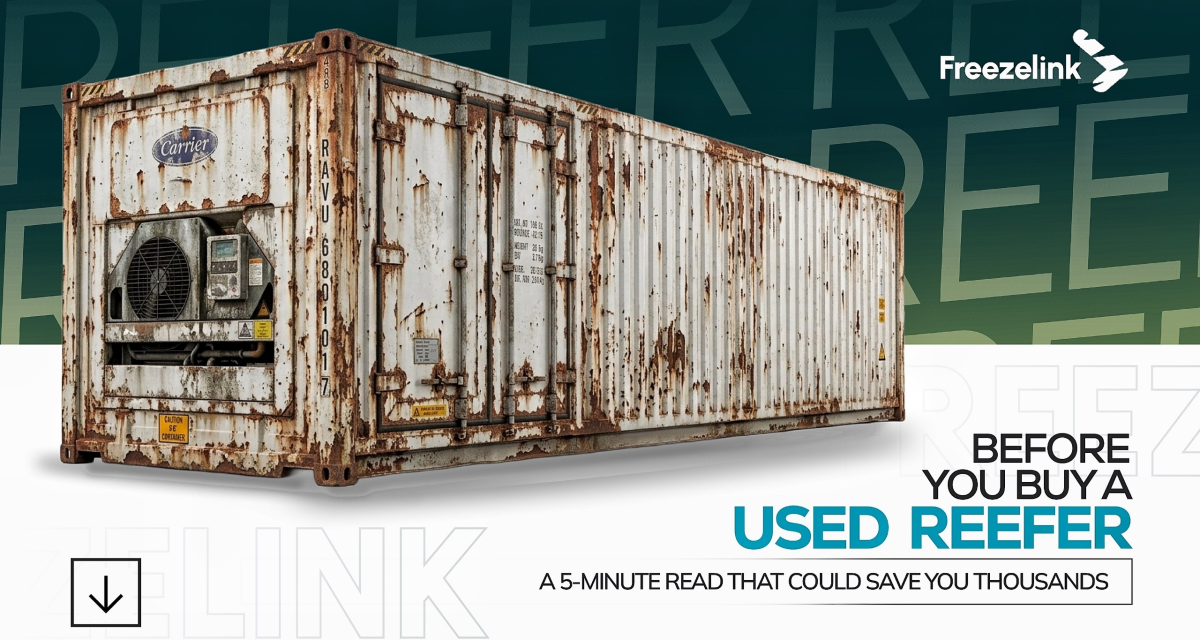
As an agribusiness owner, you know you need reliable cold storage. When you look at the local market, you’ll see them everywhere: used refrigerated containers, known as reefers, sold for what seems like a bargain price.
These are often containers that have been retired by the world’s biggest shipping lines. For a shipping company, a reefer is a prized asset, but only for a limited time. Its “useful life” at sea is defined by the quality of its insulation. Over years of hard use, that insulation wears down. Once it can no longer efficiently protect cargo on a long ocean voyage, the container is discarded.
This is the moment it appears on the local market. It seems like a smart, affordable solution. But what if that low upfront price is hiding a much bigger cost? What if the very reason it was cheap to buy is the exact reason it will be expensive to run?
Hidden Cost #1: The Energy Trap
The single biggest shock for new reefer owners is the first electricity bill. That degraded, worn-out insulation is the critical flaw.
A reefer was designed to have its insulation work with the cool, windy conditions on a ship’s deck. It was never designed to sit in the static, direct, 35°C+ heat of a Ghanaian field. Its thin, old insulation simply can’t cope. As a result, its cooling machine is forced to run almost non-stop, 24/7, just to maintain temperature.
Here’s what that costs in real terms:
- A typical used reefer can easily add GHS 4,500 or more to your monthly electricity bill.
- A modern, purpose-built cold room, designed for our climate with thick, new insulated walls, often uses less than half that, closer to GHS 1,500 per month.
That’s an extra GHS 3,000 per month—or GHS 36,000 per year—coming directly out of your pocket. It’s like buying a cheap, old freezer with a broken seal. The low purchase price is quickly forgotten when you see how much energy it wastes just to stay cold.
Hidden Cost #2: The Refrigerant Problem
It’s not just the insulation. It’s the gas inside the cooling unit that does the work.
Most retired reefers run on older-generation cooling gases. These gases come with two major problems:
1. They are energy-hungry. The old cooling system is simply not as efficient, forcing the machine to work even harder and use more electricity to get the same cooling effect.
2. They are terrible for the environment. You’ll hear this called “Global Warming Potential” or GWP. It’s a simple measure of how much heat a gas traps in the atmosphere. These old, leaky gases can be thousands of times worse for climate change than CO2. You are literally warming the planet while trying to cool your food.
A modern cold room is designed as a complete, high-performance system. It uses new, clean, and highly efficient cooling gases. The whole system is designed to work together perfectly, giving you maximum cooling power for minimal energy cost.
Hidden Cost #3: The Maintenance Nightmare
The cooling machine on that retired reefer has already endured years of harsh, salty sea air and constant vibration on a ship. It’s an old machine at the end of its service life.
Now, you are forcing it to work harder than ever, 24/7, to compensate for the poor insulation. This leads to frequent, costly, and predictable breakdowns. And they always happen at the worst possible time: the middle of peak harvest.
Business owners report spending two to three times more on annual maintenance for these used reefers compared to new, purpose-built units. But the real cost isn’t just the repair bill. It’s the stress, the downtime, and the value of the harvest you lose when the cooling stops. In an era where every single tomato counts, this is a risk no serious business can afford.
A Smarter Investment: Built for Africa, Built for Profit
A modern cold room is designed differently from the ground up, with your profitability in mind.
- Superior Insulation: Modern cold rooms have walls that are often twice as thick as a reefer’s. It’s simple: new, high-quality insulation means the cooling machine runs less, which means your electricity bill is lower every single month.
- Modern, Efficient Technology: These units use new, high-efficiency, clean cooling gases. The entire system is new, under warranty, and designed for a long, reliable life in our specific climate.
- Solar-Ready: These units are designed from day one to be easily connected to solar power. As many of our horticulture clients have seen, this can reduce your energy costs to nearly zero, turning a major expense into a powerful competitive advantage.
- A Complete Solution: Finally, you are not just buying a “box.” You are investing in a “one-stop-shop” solution. A true partner can help you finance, build, and even operate the entire system. This eliminates the risk, allowing you to focus on your real job: growing your business.
The Bottom Line: Look at Profits, Not Just Price
The decision to buy a used reefer to save money on the initial purchase is a false economy. The very reason it was discarded by the shipping line—its worn-out insulation—is what will make it so expensive for you to operate.
When you add up the extra electricity (GHS 36,000 per year) and the constant, expensive repair bills, that ‘cheap’ reefer can easily cost you over GHS 200,000 more to operate over just three years than a new, efficient unit.
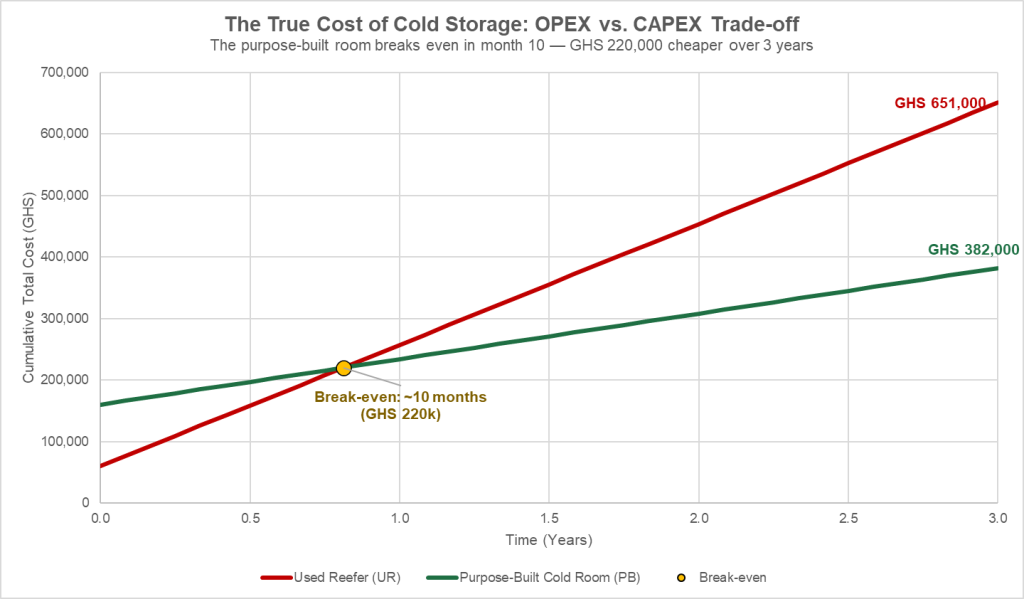
The smart decision isn’t about the lowest price today; it’s about the highest profit tomorrow.
Before you make a decision, ask the seller one simple question: “What will this cost me to run every month?”
Your profitability depends on the answer.